
Virtual Assistant vs Freelancer for Agency Owners: What's Best in 2026?
TL;DR
Recurring agency work, client fulfillment, GoHighLevel management, appointment setting, usually goes better with a managed virtual assistant than a freelancer. Cost, reliability, continuity, all of it favors the VA once the work repeats. Freelancers still make sense for one-off, specialized jobs. Simple rule: if it repeats weekly, hire a VA; if it ends when the deliverable ships, hire a freelancer.
A Familiar Friday for Agency Owners
4 p.m. on a Friday. A client's campaign breaks. You message the freelancer who built it three weeks back. Nothing. You check her profile and she's online, elbow-deep in someone else's project.
So now you're the one fixing it. Or apologizing to the client. Usually both.
Every agency owner has lived some version of this. It isn't that the freelancer was careless or unprofessional, it's just how the arrangement works. She's loyal to whoever's paying this particular hour, and today that's not you. That gap is really where the whole VA-versus-freelancer question starts to matter.
We've watched this play out with a lot of the agencies we work with at Rozi Academy. The ones who fix this early scale faster than the ones still rolling the dice on marketplace freelancers for work that never stops.
Virtual Assistant vs Freelancer: The Real Difference
Strip away the marketing language and the difference comes down to this: a virtual assistant is a dedicated team member handling ongoing work. A freelancer takes on one project with a defined start and finish.
Everything else follows from that.
A VA sticks around long enough to actually learn your business, your CRM, your SOPs, the way you like things worded in client emails. She gets faster the longer she stays, because context compounds. A freelancer doesn't have that luxury. She finishes the logo or the landing page and moves on to whoever's next in her queue.
For a typical small business, that difference is mildly inconvenient. For an agency owner, it's bigger than that. You're not just running your own operation, you're on the hook for someone else's results. A missed deadline isn't only your headache anymore. It's your client's, and it lands on your name first.
Cost Comparison: What Each Option Actually Costs an Agency
On paper, freelancers win the price war every time. In practice, that number is misleading.
Hire a freelancer directly and you're the one screening candidates, writing briefs, explaining your brand voice for the third time this year. Then if she ghosts halfway through — which happens more than most agency owners want to admit — you start the whole process over, usually with less runway than you had the first time.
A managed VA agency absorbs most of that. Recruiting, vetting, training, replacement — it's baked into one flat rate. You're not really paying less per task with a freelancer. You're just moving the cost somewhere less visible.
Our own numbers back this up. Across the 300-plus agencies we've placed VAs with, the average managed engagement runs around $600 a month in recurring value, and a handful of our longer-term clients have scaled a single role into a $1,500/month package once it turned into a full department. You can see how the pricing breaks down if you want the specifics. What we notice more than the numbers, though, is the pattern: agencies that start with freelancers for recurring work almost always come back within about 90 days asking for something more permanent.
Reliability: Why Freelancer Turnover Hurts Agencies Most
This is where the freelancer model tends to fall apart for a growing agency.
The U.S. Bureau of Labor Statistics put independent contractors at 7.4% of total U.S. employment as of July 2023, nearly 12 million people, working solo, with no employer backing them up and no manager to call when a job goes sideways. None of that reflects poorly on freelancers as people. It's just the structure. One person, one point of failure.
If that person gets sick, or a better-paying client shows up, or she just stops replying, you're left with a hole in your operations and nobody to fill it. There's no teammate covering for her. No account manager you can escalate to.
That gap costs real money. SHRM's research puts the total cost of replacing a bad hire somewhere between 50% and 200% of that role's annual pay, once you factor in recruiting time, onboarding, and the productivity you lose in between. On a $2,000/month role, that adds up fast and it's a cost most agencies don't budget for until it's already happened once.
A managed VA agency is built around exactly this problem. If a placement isn't working out, the agency finds you a replacement. You're not back at square one every time.
White-Label Delivery: The Factor Agencies Can't Ignore
Most VA-versus-freelancer articles skip something obvious: agencies resell their delivery. Freelancers were never really designed for that.
A freelancer operates under her own name, on her own hours, often juggling five other clients at the same time yours is due. A managed VA, the kind trained specifically for white-label work, operates under your brand instead. Your client never knows a VA touched anything. That's kind of the entire point.
It matters most if you're running an SMMA or digital marketing agency on GoHighLevel as your core CRM. A GHL-certified VA can step straight into a client's sub-account and start building funnels or configuring automations without a ramp-up period. Ask a random freelancer to do the same and you're often starting from scratch.
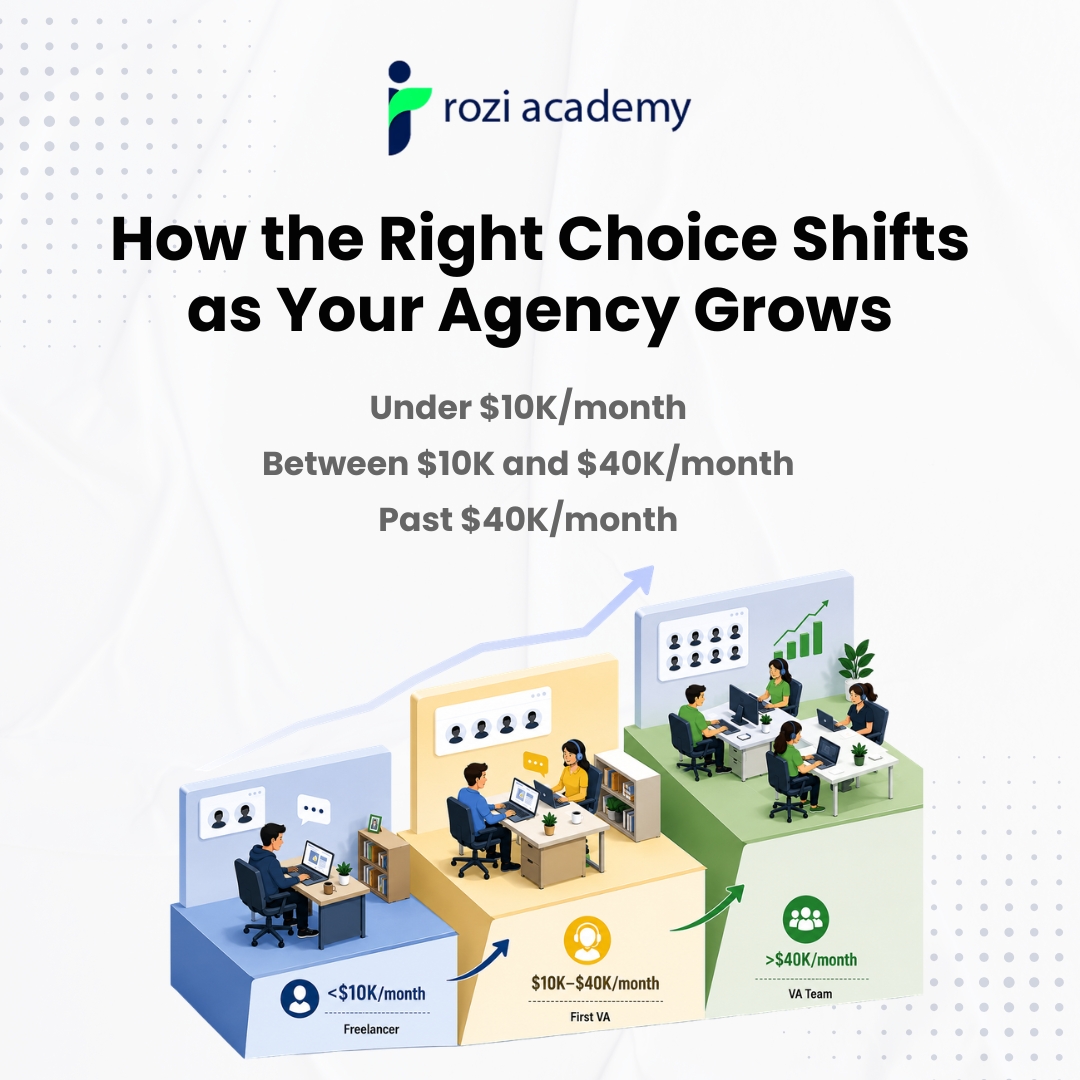
How the Right Choice Shifts as Your Agency Grows
The answer here isn't fixed. It moves depending on where your agency actually is.
Under $10K/month, you're probably still doing most of the delivery work yourself. A freelancer for the occasional project is reasonable, you don't have the volume yet to justify a dedicated hire.
Between $10K and $40K/month, cracks start showing. You're juggling several clients at once, and coordinating a rotating cast of freelancers eats up the very time you were trying to free up in the first place. This is usually the stage where agencies bring on their first VA.
Past $40K/month, consistency stops being optional. Clients expect the same quality month after month, and losing one freelancer can put a retainer worth thousands at risk. Agencies at this stage tend to run several VAs across different roles, each accountable to your team instead of a rotating client list.
Knowing which stage you're actually in changes this from a one-time decision into a staffing model you can grow into.
When a Freelancer Is Genuinely the Right Call
None of this means freelancers are wrong. They're the better call in a few specific situations:
A one-time brand redesign or website build
A single, technical project outside what your team currently knows how to do
A short campaign with a hard deadline and nothing ongoing attached
Testing a new service line before you're ready to commit to a full-time hire
If the work has a real finish line, freelancers are often faster and cheaper full stop. The mistake isn't hiring one. It's hiring one for work that was never going to end.
Common Mistakes Agency Owners Make in This Decision
Hiring on an hourly rate alone is probably the biggest one. A $12/hour freelancer you re-hire every three months ends up costing more than an $8/hour VA who just stays a year.
Handing a freelancer long-term access to client accounts is another. You're giving ongoing access without the accountability that should come with it, that's a bigger security risk than most agencies realize until something goes wrong.
Treating every task the same way trips people up too. Not everything belongs with a VA, and not everything belongs with a freelancer. The real mistake is defaulting to one model for the entire workload instead of matching the model to what the task actually needs.
And skipping the trial period. Whichever route you take, test the relationship on something small before you hand over full client accounts.
The Decision Framework
Run any new hire through these four questions:
Does the task repeat weekly or monthly? If so, that's a VA.
Does the quality get better the longer someone's in the role? Also a VA.
Does the work end the moment one deliverable ship? I'm a freelancer.
Will clients ever interact with this person directly, and does consistency matter there? VA, under your brand.
Most agency owners who actually run this checklist honestly end up finding that 70–80% of what they're delegating belongs with a dedicated VA, not the rotating freelancer roster they've been leaning on.
Conclusion
None of this is really about which model is objectively "better." It's about matching the model to the shape of the work sitting in front of you.
Recurring, client-facing work, the stuff that repeats and gets better the longer someone owns it belongs with a VA. One-off projects with a clear end date still belong with a freelancer, and there's nothing wrong with that. Where agency owners get burned isn't picking the wrong model outright. It's using the same model for everything, regardless of whether the work was ever supposed to end.
Get this right once and you stop re-hiring the same role every few months. For a growing agency, that's usually worth more than whatever you'd save on a freelancer's hourly rate.
Get Matched With a Managed VA
If a freelancer has already cost you a client, another marketplace search probably isn't the fix. We've placed VAs with 300+ agencies, starting at $5/hour, with placement in 24 hours.
👉 Book Your Free Discovery Call
FAQs
Is a virtual assistant cheaper than a freelancer long-term?
Usually, yes, at least for recurring work. Freelancer rates look lower on paper, but the re-hiring and management time tends to close that gap over a full year.
Can I use a VA and a freelancer at the same time?
Sure, and plenty of agencies do exactly that, a dedicated VA for daily operations, freelancers brought in for the occasional rebrand or technical build.
What's the biggest mistake agency owners make in this decision?
Hiring a freelancer for something that never actually ends. If it's on your to-do list every single week, that's a VA task.
At what revenue stage should an agency hire its first VA?
Somewhere between $10K and $40K/month is typical, right around when juggling multiple freelancers starts costing more time than it saves.
How fast can I get started with a managed VA?
We typically place a matched VA within 24 hours of a discovery call. Freelancers, even good ones, often need two to four weeks to hit full productivity.
Do virtual assistants understand GoHighLevel and CRM tools?
A GHL-certified one does. Most freelancers don't have platform-specific training, so expect a longer ramp-up before they're actually useful inside your CRM.
